To the seven beautifully contrasting sounds of solfege,
do re mi fa sol la tsi
we need only add five more (beautifully constrasting) sounds to meet our chromatic needs.
va wu xe yu ze
Where have all the sharps and flats gone? We can leave them to the wisdom of the listener as we do when music is performed.
Could we offer a style I call ID-Head in that the identity of the note is contained in the note head?There is nothing new about this: Musescore already offers beginner’s a notehead option which can be set to a lettername or Fixed or movable solfege. However I feel it is trying to fit in too much information, often using two letters (initial and first vowel) for note ID. Here’s an example of a pentatonic tune that beginners could play on the black notes of a glockenspiel if they could more easily read the notes.

Heres how it might be written in ID-Head, first in movable solfa, written in lower-case italic:

The coloured stave lines allow the note ID to jump out while the black notes are below given their own fixed notes names VW XYZ written in upper case. X is the tonic and V the dominant.

Although F# is the tonic of this tune the listener experiences no sharpening of it or any other notes in the melody (unless they have perfect pitch and came down on the side of F# rather than Gb). The black notes have been allowed to be tonic of a tune since around 1550 in the work of blind lutenist Gorzanis yet so far they have not aquired independant names. Perhaps the names Va Wu-Xe Yu Ze will grant them independance. They were devised in discussion with Richard Parncutt . psychoacoustician at Graz University, made from the last 5 letters of the alphabet with added vowels to contrast with the surrounding solfege whether fixed (upper case) or movable (lower case italic).
Va Wu Xe Yu Ze vawu xe yu ze
Do Re mi Fa So La Si do re mi fa so la ti
To contrast with their neighbours Xe is pronounced as in Greek (a voiceless hiss from the back of the tongue, and Ze is pronounced as in Spain ( like the English word they).
From these examples you can may have noticed the adaptation of conventional rhythmic symbols summarised below:

whole-note half-note quarter-note eighth-note
semi-breve minim crotchet quaver
Fortunatey the “black note” initials combine distinctivley with various “white note” conventions.
Transatlantic
V W X Y Z
C D E F G A B
German
V W X Y Z
C D E F G A H
Mediterranean
V W X Y Z
D R M F S L $
In the following map, below the dotted line are countries that favour the fixed solfa note names (La Si Do.etc) while above the line Transatlantic names ( ABCetc) are prevelant.This usage tends to extend globaly into the ex-colonies.

Si is named after Santa Iohannes (Saint John) who closes the hymn from which the other solfege syllables get their name. By using the dollar sign for Si we can compress this history into a single symbol. Luckily F has the same meaning in Transtlantic, German and Mediterranean.However the meaning of D is different according to context. It could be made more distinctive by placing the second letter of Do within the initial or when short of space, a dot.

The underlying philosophy of ID-head is that sharps and flats are very real experiences which we can leave to the listener as we do when music gets played. Here is the opening of a piece by Wagner, Wolfram’s Song from Tannhauser written in three versions:Fixed Solfege, Transatlantic and movable solfa.
i) fixed solfege

The key signatuere is no longer needed for the right notes to be played but it may be still useful to include as a reference. Its inclusion could be an option. the ID-Head is only presented when the note is first sounded: tied notes are written as conventional noteheads.
ii) Transatlantic

When in fixed solfa or Transatlantic shared notes between left and right hand are more apparent in ID-Head than in traditional notation, especially for the beginner.
iii) movable solfa

This form gives the melody and harmony from the viewpoint of the tonic, giving their role within the key.
Popular melodies re often written in lead sheet form, that is the melody with chord symbols with optional lyrics. Popular melodies are often written in lead sheet form, that is the melody with chord symbols with optional lyrics. Here is the tune Quizas, Quizas, Quizas writtenin various styles of ID-Head;
i) fixed solfa
ii) Transatlantic

iii) movable solfa

Singers like to choose the key that suits their voice. A lead sheet in movable solfa is a kind of harmonic analysis can then be played in any key.
ID-Head bypasses the elitist grammar of treble and bass clefs, key signatures and accidentals yet allows the beginner to pick up the rules of time signatures, rhythmic notation, dynamics and articulation so they can ease into traditional notation later.
Chromatic Solfege might soon be added to the app on the phones of practically all jazz musicians these days. iReal Pro quickly comes up with the chord the sequnces of hundreds maybe thousands of jazz standards, transposing them to any of the 12 keys in an instant.
It also offers a harmonic analysis of each tune: go to the font menu and your chosen tune will be shown in Nashville aka Number Notation with the major tonic shown as 1. This was used by Elvis Presly’s band so they could try different keys till he found the ideal one for his voice.
Unforunately, with Nashville the minor key is the underdog, coming out as 6, and the sharps and flats can get in a bit of a tangle. Via the iReal support page I got into conversation with the management team suggesting that it would be nice to add ChroSol as a font option alongside Nashville. They said they might think about it but asked me to just use do (not the old name ut). So I sketched these graphics of how some tunes might look on your mobiles or ipads, one in the major- All the things you are, and two in the minor, Blue Bossa and Cry me a river. I used the font Corgette for the chord roots and kept the iReal fonts for the chord symbol part.
iReal Pro gives you the choice of showing a minor chord in the normal way eg Am or in the jazz shorthand A- . The latter is the best option in a solfege context to avoid confusion with the note mi . If we want to show that a note is the root of a major chord, and not just a melody note, we can use an upward arrowhead (6+shift) eg A- A/C# D- E7 A^.

If you search the minor tune Blue bossa in iReal its harmony is analised in the Numerical Notation font as if was in the parallel major. The major/minor flick sometimes happens in tunes eg the bridge of Perhaps, perhaps, perhaps so I thought it would be interesting to compare both viewpoints, the minor and the major.
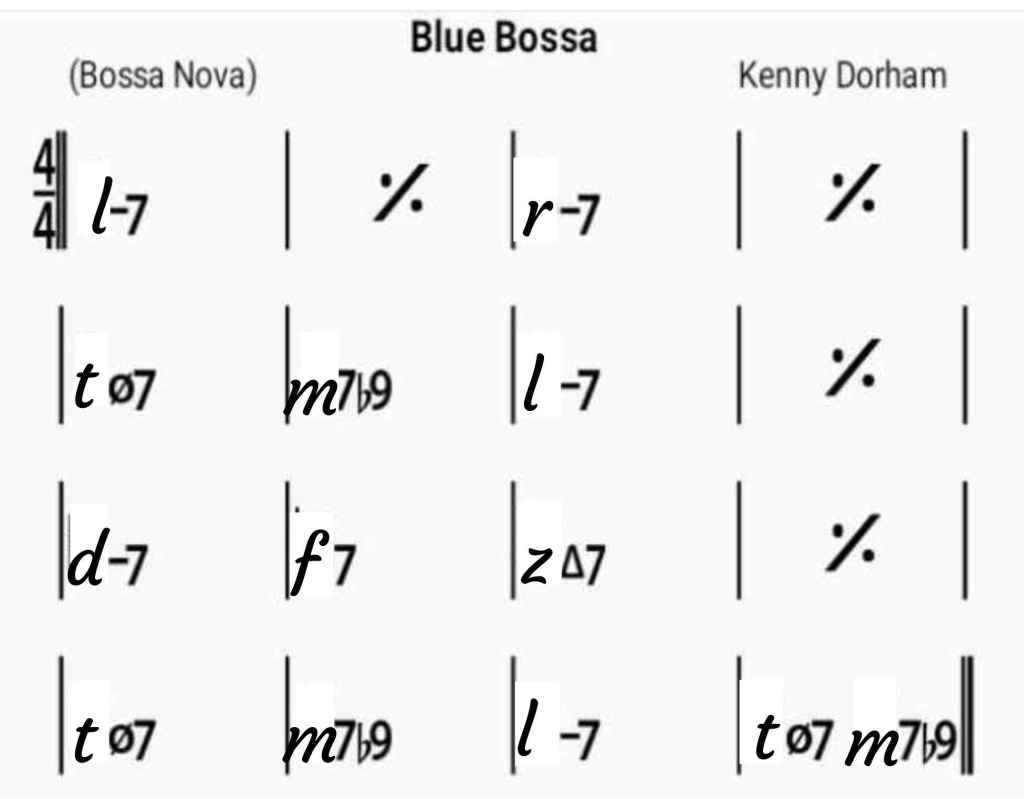
It is interesting to compare how the common root patern 2 5 1 turns out when heading to la as in tØ m7 l- or heading to do as in rØ s7 d-. The 2 5 1 appears again in the 9th bar as d-7 f7 z^ in the first version and w-7 y7 v^ in the second , a rapid modulation to the slattened super tonic, a faily distant key. It could be said that 2 5 1 is the polite way to enter a new key as we saw in bar 6 of All the things you are x-7 t7 m^ and in bar 9 l-7 r7 s^, and later in bar 14 we find v-7 x7 t^ and in bar 21 zØ w7 y^.

Cry me a river I first heard as a teenager and it has stuck with me ever since. Each A section begins in the minor and ends the relative major while the bridge is in the dominant minor, m-.

While the iReal Pro team are looking and the pros and cons of adding the ChroSol option I will be going through the following paragraphs updating.
************************************************************************************************************
…the examples below the ut is yet to be replaced by do. ..
This page has sub-pages blacknote pentatonic tunes, iRealX , melharmony & piano pieces. To view sub-pages hover over the Chromatic Solfege in the top of page list and the sub-pages will appear.

Usually learning music starts with the piano white notes. But you can also start with the black notes with their own names VW-XYZ, memorable as the last five letters of the alphabet, with vowels added Va Wu – Xe Yu Ze making nice contrasts when sung. Here’s a pentatonic play-along using the pictured instruments, first My Paddle’s Keen and Bright aka The Canoe Song followed by Over the Sea to Skye. The Canoe Song was originally written in 1918 by Margaret Embers McGee and people enjoy playing it with their own variations.
Here’s a beautiful sung version of the Canoe Song by RocknMusic lifted from YouTube and transposed up 1 guitar fret to match the black notes.
And here’s the first of the tunes in the above play-along Canoe Song in simple notation.

This special grey stave provides a background against which beginners can follow the contour and rhythm of the melody, learn how up and down on the page relates to the pitch. The key signature and time signature help knowledgable reader music feel at home. If and when the beginners come to read from a tradition staff many reading skills will already be developed.
The glockenspiel or xylophone is an ideal way to start playing music without any fingering complications. Instrument makers could produce cheap black note sets to which matching white notes can be later added or fitted.
Panpipe workshops can produce “black note” versions on request. Traditionally the panpipers have low notes to the right, opposite to the layout of the piano. An option is to request pipes set in a straight line which can be played from either side.
Every culture has some pentatonic tunes that can be added to the black note collection which will be in the subpage accessed by hovering over the VW-XYZ page in the top menu. Please let me know your favourites. If you like to send me some in your own handwriting they would be most welcome.
Luckily the black note names combine distinctively with widespread notename traditions traditions:

It remains to be seen which of the above combinations develope a readership. Solfege has over the past two hundred years developed two meanings – according the use of upper case (meaning fixed) verses lower case (meaning transposable). It’s handy to be able able to write notes by their initials so lets blend the Si and ti into Tsi. Sing it as Tsi, Si or Ti.
Another way to make the upper case initials distinctive is to pop the vowel of Do inside the upper case D threby therby distinguishing fixed Solfege D with the transatlantic D.

By pure conincidence one of the initials is shared by both systems, Fa and F
ChroSol (chromatic solfa/solfege), is a dialect made of two main components, the 5 black notes Va Wu – Xe Yu Ze and the 7 white notes Do Re Mi Fa Sol La Tsi of traditional solfa . The virtue of contrasting vowels and consonants continues as the black and white notes are combined into the 12 notes of chromatic scale. Take a listen.
How to pronounce Xe and Ze? To contrast with neighbours the Scottish loch sound can be used for Xe, which was the ancient Greek pronunciation, while Ze can use the Castilian pronunciation (European Spanish) to be sung as the English word they, as was sung in the demo above.
The black note names are the creation of Australian psychoacoustician Richard Parncutt and myself. On the penta-heptatonic-chromatic duet I was joined by Ruby Hamill.
ABCDEFG are the older note name proposed by Boethius around 550 having the disadvantage of similar vowels between 4 neighbours BCDE. Solfa, featuring contrasting vowels throughout was proposed by Guido of Arezzo around 1050 based arround the ascending starting notes of of a hymn, Ut queant laxis, demonstrated in this short video.
Seas, mountian ranges and political influences have all contributed to this note name boundary across Europe (ABC.. above the dotted line and Do Re Mi …below) and carried world wide in the colonial era. It is useful to call ABC etc the Transatlantic note names, and Do Re Mi etc the Mediterranean note names.

The diagram below summarises the variations Solfa has undergone over the centuries, compared to the alphabetic names attributed to Boethius.
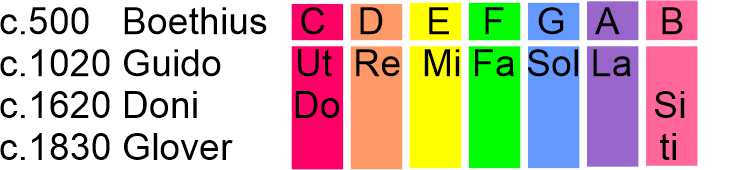
Ut had been the only note starting with a vowel but around 1620 Giovanni Battista Doni took the first two letters of his name, Do, to replace Ut so that this note could also begin with a consonant. Soon after solfa received its seventh note Si formed from the initials Sancta Iohannes (Saint John) to whom in the hymn is dedicated. The last modification in the diagram is that the English music teacher Sarah Ann Glover who around 1820 chose to replace the Mediterranean Si with Ti so as to produce a disctinctive intial. She also made the innovation of using upper case to represent fixed notes (La=440Hz as is still used in the Mediterranean) and lower case for transposable as she demonstrates in the picture below. Italic is useful to avoid the ambiguity of the non-italic l which can easily be confused with the number 1 (depending on the font in use). In ChroSol Si and Ti are blended into Tsi which can sung as si, ti or tsi.
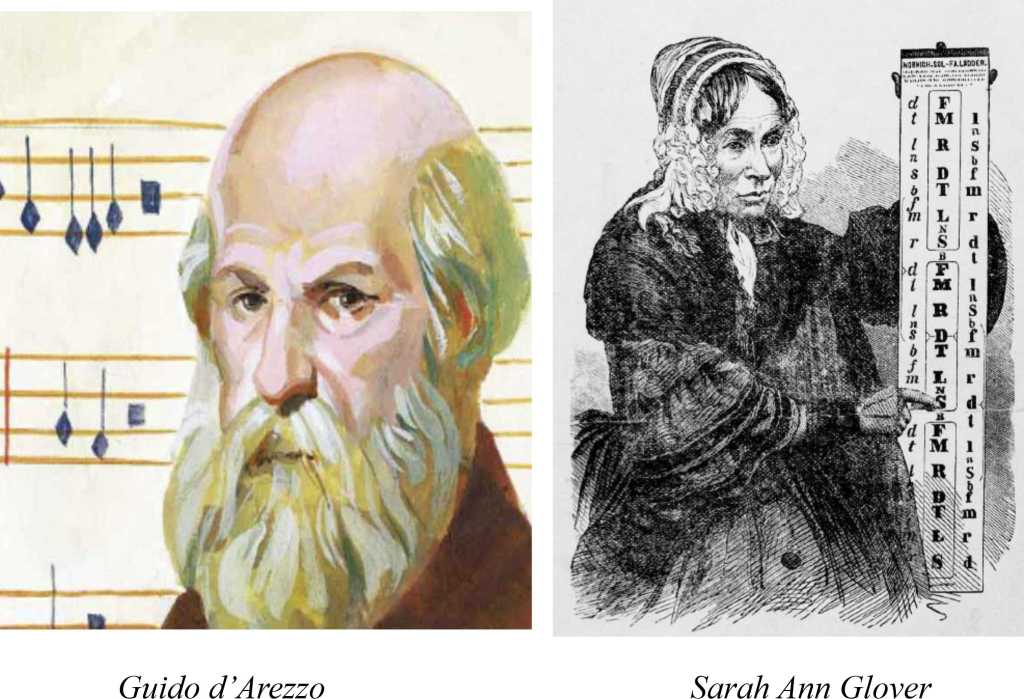
It looks like Sara Ann may have had suggestions for “black note” names, n and b, but they haven’t caught on. But her “Ti with jam and bread” is written in celluloid in this iconic clip as Do Deer is sung with seven children, each representing a a note of the heptatonic scale (aka diatonic).
Sharps and flats can be real (Hoi! You’re tinkering with our precious scale) or fake ( just waiting for some decent black note names to come along). A good example of a real flat is the first two phrases of the song How High the Moon.
https://www.youtube.com/watch?v=tdLkbfyysGI
A good examples of fake sharps and flats are to be found in the opening bars of some of Bach’s 48 Preludes and Fugues. When the piece is in the key of a black note we do not experience any tinkering at the begin while the key is being established. The keyboard layout of black and white notes was estableished around 1350 and it took a few centuries before the black notes could be considered worthy of being keynotes, let alone have their own names. The first time black notes were given tonic status was probably in the dances of the blind lutenist Gorzanis in 1576 (see the related page on this site). On the lute the notes of chromatic scale dont feel so different as on the piano.
Chromatic notes are often involved in modulations (key changes) but are also used as a striking depature from the normal, such as these unforgatable three notes do xe sol. Try to guess the tune: if you can’t sing it to your friends. Clue: it may be a whisper from Shakespeare.
If the tonic of a piece of music is a flat or sharp the name is fake as we do not experience it having been tweaked. Tonics don’t often get get tweaked at the beginning of a song when they are trying to get themselves established. Real or fake, we can leave those issues to the listener, as we do with guitar/lute tablature and indeed when any music gets performed.
There needs to be a large body of music to make it worth learning to read ChroSol. Software is needed to translate from traditional notation. Meanwhile this site will build collections of music under the following subpages, which can be accessed via the title page at the heading.
black note pentatonic tunes starting with examples for beginners
melharmony (where melody and harmony are indicated by the same names) interesting pieces from the jazz, pop and classical repetoire
the verses of jazz satndards often needed by singers who may not be sure what key fsuits them best : this is where movable solfege comess in useful.
piano pieces offering beginners easier note identification, bypassing key signatures and accidentals while retaining the general look of traditional piano music so that players and teachers move from one setting to the other.
By using letters as noteheads we are not relying on the notes position on the stave to gain its identity but using the stave to illustrate the melodic shapes: there is another advantage in use the five line staff, in that it maybe a stepping stone to reading traditional noteheads with its secretive noteheads. Also music teachers may find themselves needing to switch back and forth betweeen the two systems.
Re the chord sequences of tunes: We can use the jazz standards to get acclimatised to ChroSol. Most jazz musicians now have the app iReal Pro installed on their mobile phones or tablets. It gives the chords of thousands of tunes using the Transatlantic note names. It is also able to show the chords in terms of the tonic aka keynote using degrees of the major scale as roots, a form known as Nashville or Number Notation. Here is the chord seeequence of a basic 12 bar blues.
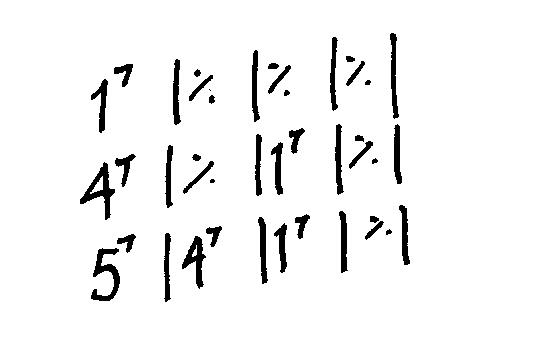
Unfortunately, in this notation the minor tonic comes out as seecond fiddle. Here, for example, are some typical chord sequences shown as Transatlantic, Nashville and movable solfege.

This demonstrated in Lionel Ritchie’s beautiful ballad Hello . La is the minor tonic.

Note that the la triad changes from minor to major before the song sets off on the journey round the cycle of 5ths – r- s^ d^ f ^ z^ m+ m^ These are all triads and introducing the chromatic note z he avoids the weak sound of trf, the diminished triad. The z triad is major, a dramatic challenge to the tonic, known as the Neapolitan chord.
Another way to avoid the weakness of the diminished triad is to add a seventh – t r f l . The seventh chords became popular in the early baroque period, around 1620, and it became common practice to go round the cycle of 5ths using 7th chords, clockwise in this diagram, starting anywhere. This is known as the tonal cycle of 5ths. The fifth down between f and t is a diminished 5th (only 6 guitar frets) which keeps the cycle within the familiar seven note scale.

Note there are three minor 7ths chords and two major 7th chords. Two chords are unique, our trfl chord, known as minor 7th b5 or half diminished (shorthand Ø) , and the 7th, though m-7 is often altered to m7 if it is to act as a more typical dominant chord of l- .
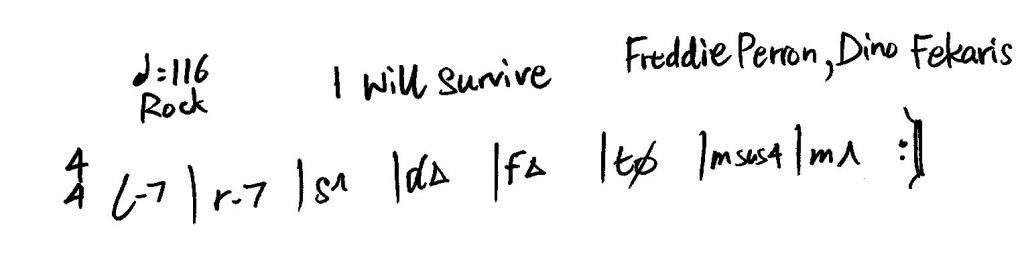
The tonal cycle of fifths came into use around 1600 and there are many examples in popular eg Autumn Leaves and Fly me to the moon. Another example is the song I will survive recorded by Gloria Gaynor.
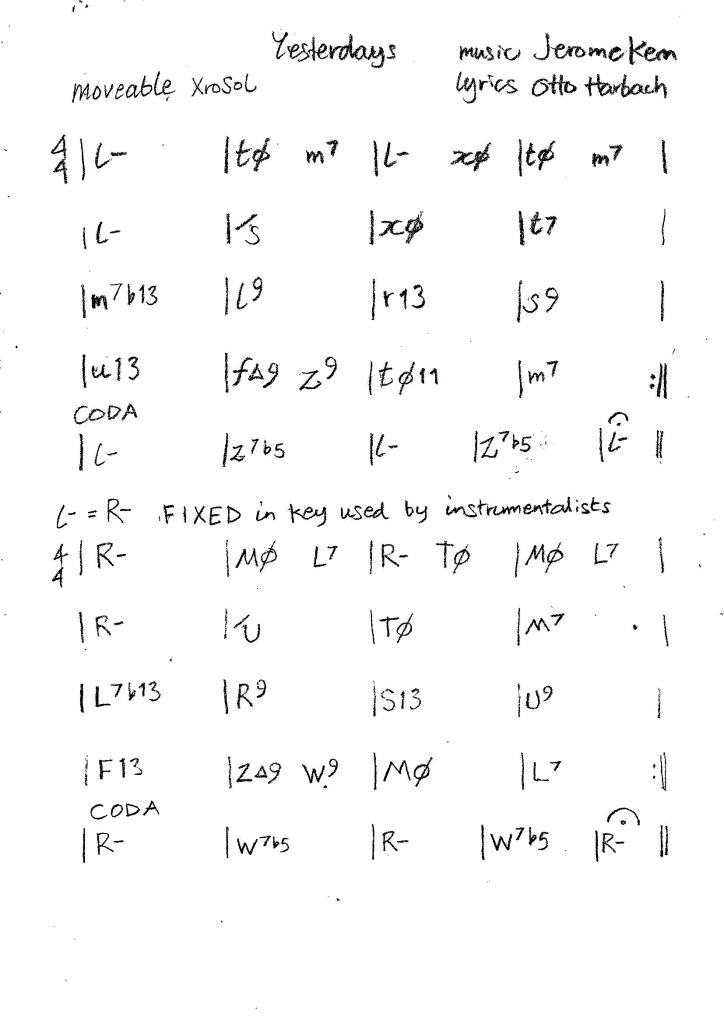
The difference in meaning between lower and uppercase is shown in the jazz standard Yesterdays, given first with l- as the minor tonic playable in any key, followed by the same chords in the key most often used by instrumental players R- aka D minor. After establishing the tonic in the first four bars it begins a journey round the cycle of 5ths from x to w (x t m l r s d f z w).
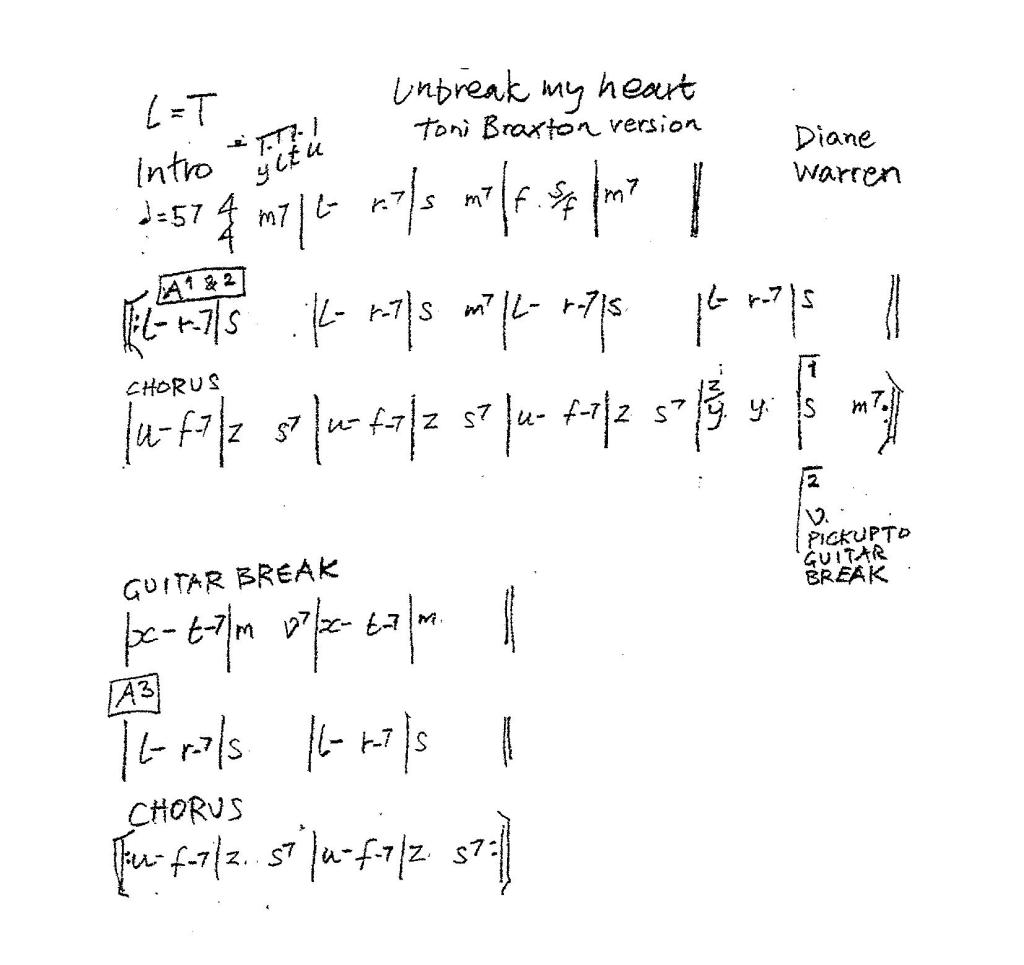
There is beautiful song that offers various way of writing chords in the minor key , that is Unbreak my Heart which I happened to hear on the car radio while making a recycling trip. Toni Braxton in T- (aka B minor) and the chorus moves to R- and guitar break is in F- , in all instances using similar slow moving chords. Toni’s is a most touching rendition and I wrote this harmonic analysis as soon as I got home.
Singers have a more limited range than most instrumentalists and there is a subtle change of quality across their range. Consequently singers are more likely to change the key of piece to find their sweet spot. While iRealPro can provide the chords of the main part of the song in any it can not provide the introductory verse to avoid copyright difficulties and I often get asked to write out the verses by singers. I would be happy to write out any verse in movable chrosol then it can be tried in various keys which will be a good way for us accompanisits to get used to the dialect. Let me know the title and if you have a favourite version in mind. Meanwhile we will build up a collection of introverses on the page verses of jazz standards.
The Melharmony of a tune. A pupil of mine became interesting in the tune Waltz for Debby by Bill Evans. It is a jazz standard that I have found puzzling so I thought it would be interesting to look at the melharmony of it, here below. It is actually written on a chromatic stave with the white lines separated by 3 guitar frets but you can use it as a general guide to melodic shape.

The form of the tune is typical AABA but each A is different and the last A extended from 8 to 16 bars.
While harmonic progressions get passed from song to song the melody is more distinctive and therefore the precious treasure of the songwriters and their publishers. A tune’s appearance on this page will encourage students of harmony to compare versions on YouTube or Spotify so it may be quite profitable to leave it open for discussion. However a tune will be removed if the copyright holders object.
Here is the melharmony of a beautiful classical piece Saint Seans’ The Swan . This help us to understand the beauty of the relationship between the melody, its harmony and changes of key, which are hidden in traditional notation from most except for the very experienced.
Piano pieces. Here is a Minuet taken from the Notebook which uses a conventional stave.
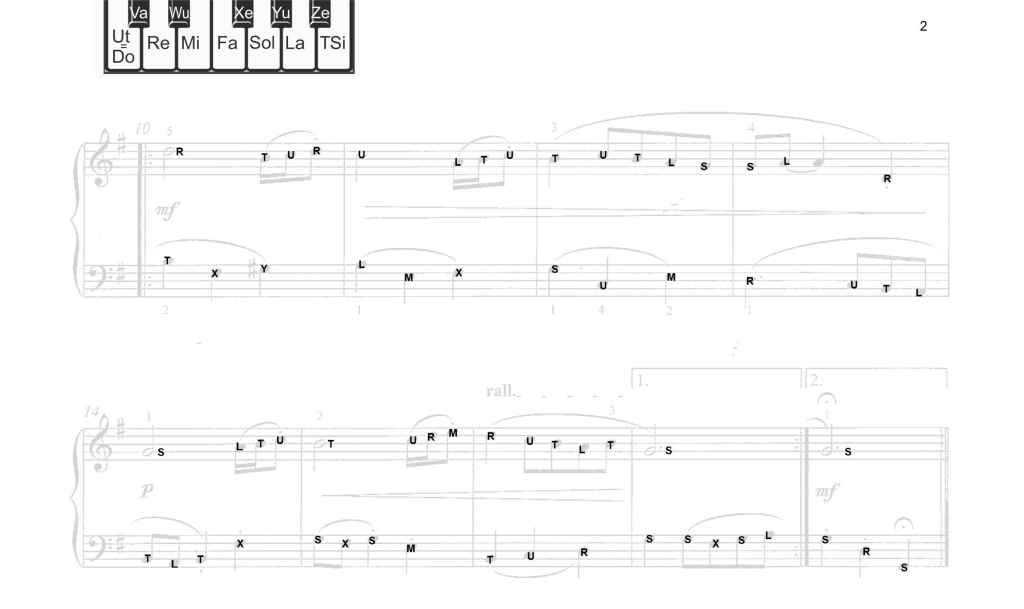
This is a minuet taken for the Trinity Grade 1 exam pieces. Fixed Chromatic Solfege has been supermimposed for those who might find reading traditional notation problematic.

The 12 frets per octave of the guitar illustrate the options from which we can select an infinity of scales and chords:. or shall we use the assymetrical 7 note scale, ABCDEFG, plus sharps and flats to describe that infinity?
 Bob Stuckey