Here’s a little ditty that will help you find your way around a particular key.

This link will take you to the ditty in all 24 major and minor keys. You can work your way through or just find the scale of a new piece you are starting. https://bobstuckey.com/wp-content/uploads/2025/08/24-keys-for-simple-piano-1.pdf: A Simple Piano Guide to the 24 Major and Minor Keys.
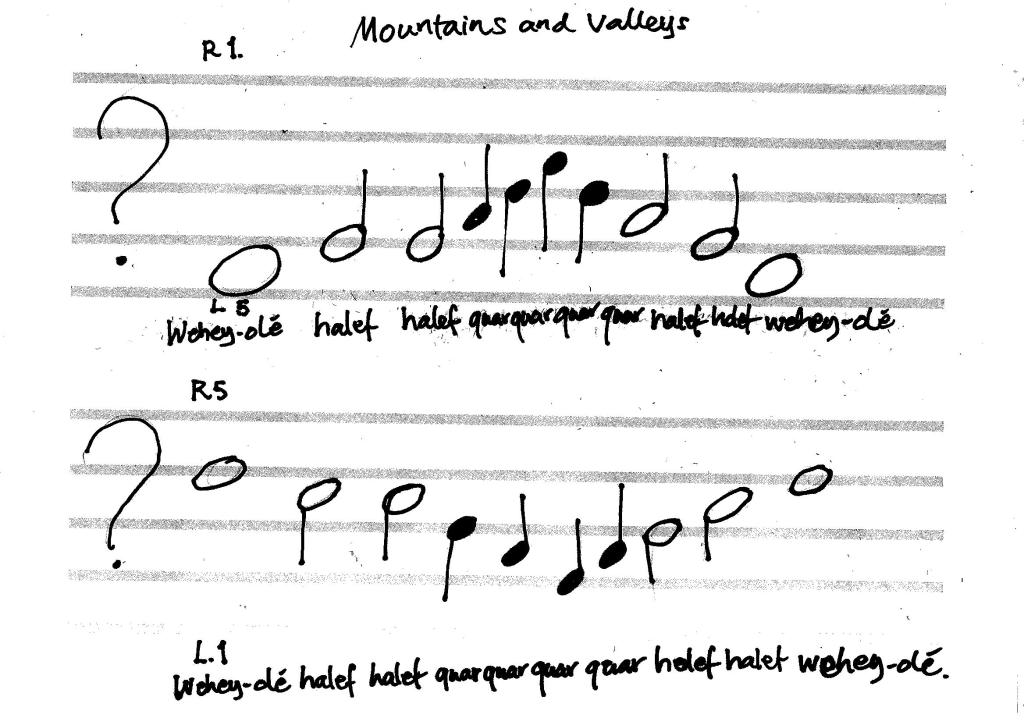
Floating Piano Fingers is a collection of five finger excercises that can be started on any white note as chosen by the pupil. They help the beginner get used to the look and feel of whole-notes , half-notes, quarter-notes and eighth-notes and musical intervals up to a 5th. Here’s and example. The pupil and teacher are encouraged to sing the rythmic names as they play.
What makes the piano special? Click here for some background.
This mnemonic blends the 21 notes of the bass and treble clefs into a single story about bears, dragons and eagles, each word helping you find the note on the keyboard.
Just to be contrary…here’s a song The Falling Leaves that introduces your first piano scale, in your left hand, desceninding and a minor scale. Don’t worry – right hand gets to have a go , and the major scale.
The lead line is sung by Ruby Hamill with her mum Rebecca Hollweg on alto: I sang tenor and young Nathan Morgan-Newham sang bass. We all sang our parts separately during lockdown and they were magicked into the same time and space by engineer/bassist Andy Hamill, Ruby’s dad. A bit of fun.
If you want to try this tune to show beginners their first scales here’s the music: https://bobstuckey.com/wp-content/uploads/2022/06/the_falling_leaves-piano4.pdf
If you want to get your own choir together to sing with soprano, alto, tenor and bass then click here for the full downloadable sheet music: https://bobstuckey.com/wp-content/uploads/2022/06/the_falling_leaves-satb-pt-12-1.pdf
There’s a charming version of the Canoe Song on YouTube. Click here to watch, listen and join in https://www.youtube.com/results?search_query=canoe+song+rocknmusic . I made an arrangment for simple piano in the same key, D minor. There’s a simple accompaniment part for another person to join in. When you can paddle along there’s an option to lift the key one guitar fret while keeping the same fingering. Click here to view or download The Canoe Song simple piano .
Tri-angle, tri-pod, tri-ple all the 3 of something while triad has 3 notes e.g ACE. We can juggle them around yet they keep their recognisable character e.g CEA, AEC. To help beginners get used to juggling triads I wrote this little melody Stacking Triads . Page 2 and 3 are just a scaled up version.
This is an beginners arrangement of America from West Side Story . It illustrates how the time signature 6/8 can easily change from 2×3 into 3×2. The teasing dialogue in the song is shown as a dialogue between right and left hand. To get in the mood watch this amazing YouTube clip.
Click here for an arrangement of the Chanuka song Maoz Tsur for beginner’s piano. The left hand is simple but melodic.
It takes a while to learn all 24 major and minor triads on the piano. They can be quite confusing . Some triads have a white major third and a black minor third, then for some its the opposite, For some both major and minor thirds are white. Click here for a guide to your journey.
If a note has a perfect 5th nearby it lifts its status. It might get to be the boss of a chord, the root, or the boss of a scale, the tonic. If you want to be tonic of a tune it helps to be heard first and last- but look out: every major scale has its relative minor, e.g C major and A minor, called relative because they use the same 7 notes, but they can squabble throughout a piece, each one trying to get the last word in. So I call them the “Jealous Cousins”. To get to know them play their triad in the left and one octave in the right:

Change the key signature and you get a different pair of cousins. Perhaps you might like to meet them all or just meet the ones of the piece you are learning. To search the Jealous cousins in all keys give them a click The_Jealous_Cousins tr-i-ad2 .
Playing scales which need different fingering for each hand can present difficulties for the learner. Click here to print off charts that place the 24 major and minor scales in three groups according to the pattern created between the fingering of both hands.
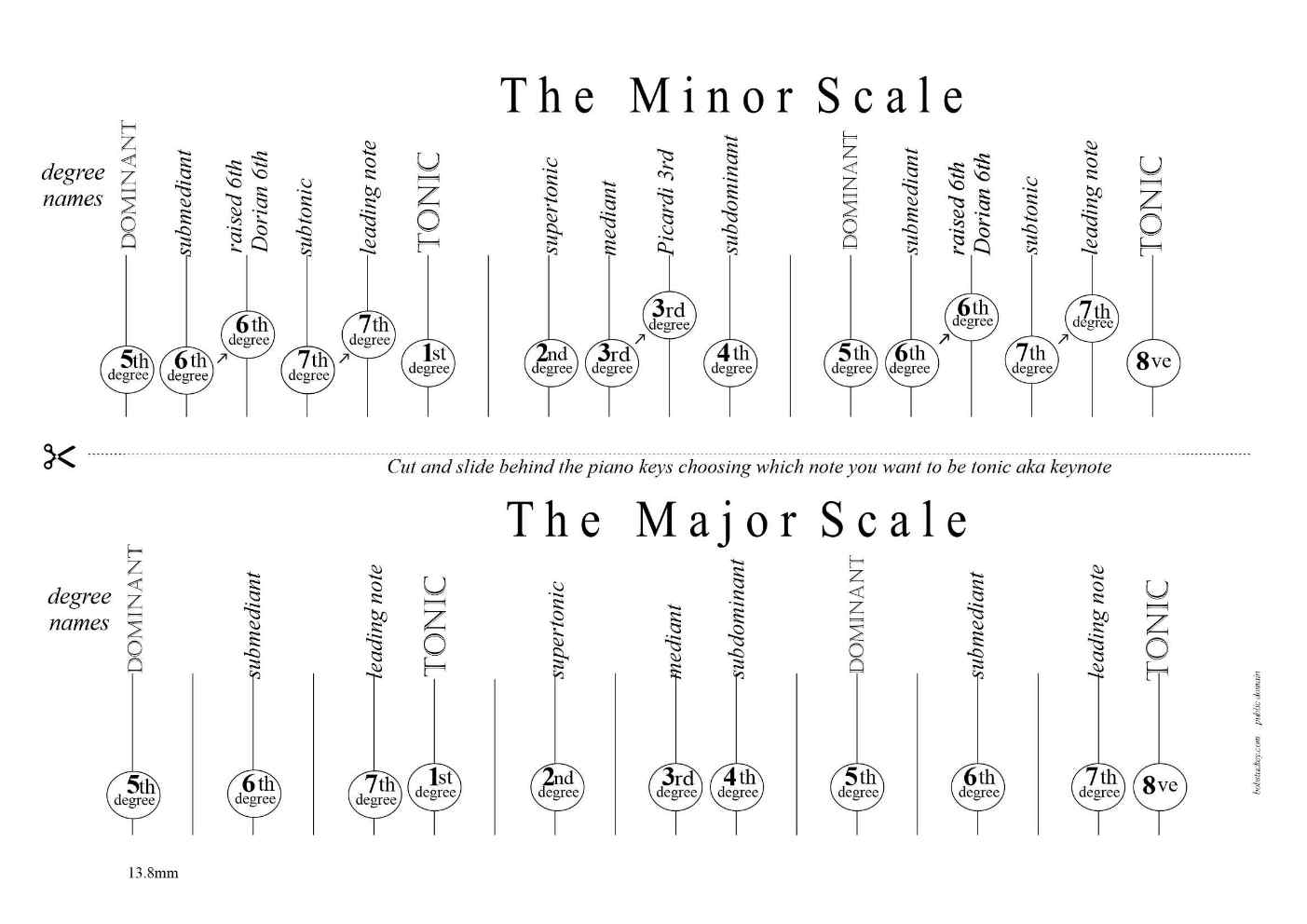
As you continue your exploration of the 24 scales it may be useful to have these two small diagrams to slide behind the piano keys, one for the major and one for the minor,
Every key signature offers you 7 notes. Out of those 7, only 2 notes usual get to win the battle to be top dog, the major tonic and the minor tonic, do and la. That can’t be fair. Don’t any of the other 5 notes get to be tonic? Sometimes they do, each creating their own unique atmosphere.
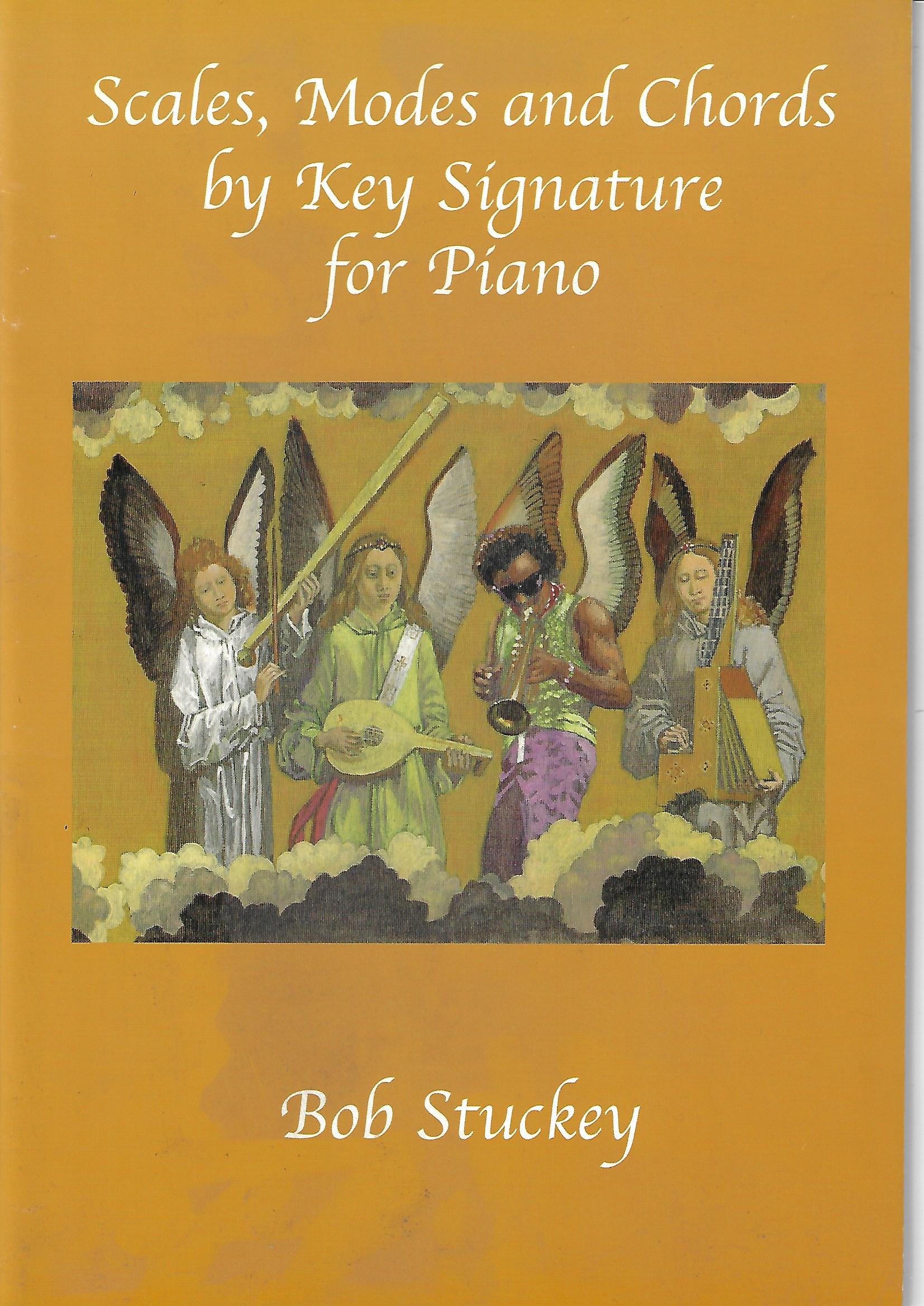
The front cover shows Miles Davis jamming in the Dorian mode with Renaissance angels becuase in the Renaissance the modes were in fashion but chased out by the major and minor scales with the arrival of Baroque in the 1600s. See the art and design page.
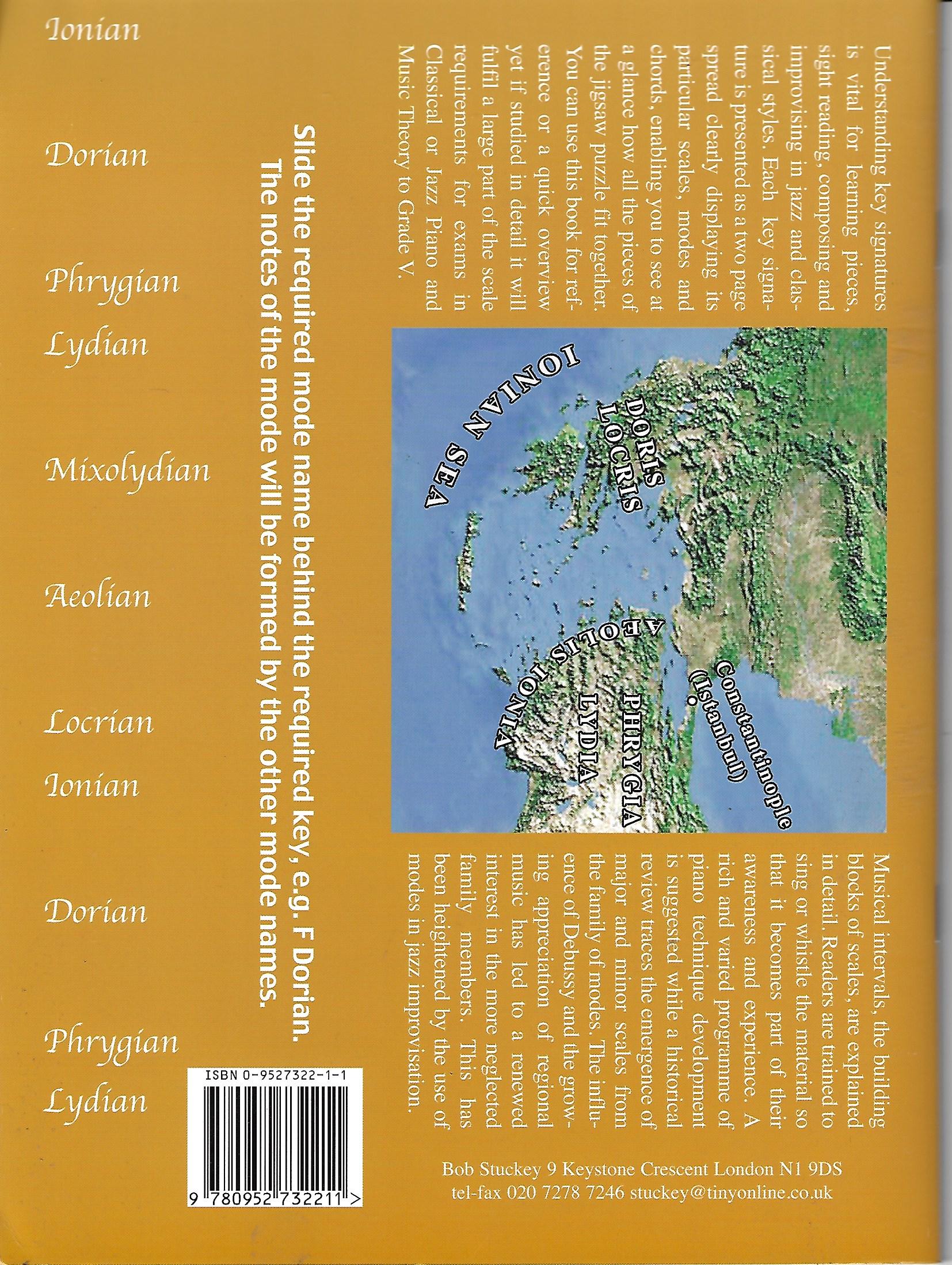
The back cover has a parade of modes that you can line up to any note on the piano keyboard to get transpositions of the modes and a map of the regions of ancient Greece that they borrow their names from.
The book is available on ebay.co.uk. Search for scales, modes and chords for piano or click this link:
Here’s an outline of the ground covered.

It’s not easy to read piano music. You need to solve four puzzles before you can be sure you’re playing the correct note.
Are you reading treble or bass?
Can you count up and down the clef without getting lost?
Is there any key signature to remember?
Is there any accidental to remember?
Sight reading on piano with its two clefs and frequent chords is more difficult than many other instruments. Try to do a bit every day. Choose something short and enjoyable and slightly challenging. Get the time signature turning over in your mind and then allow your tempo to be a little bit flexible (a touch of rubato) so you can concentrate on dynamics and bringing out the story of the piece so that it sounds highly expressive. As the actors say – ham it up a bit so they can’t tell whether you’re overcome with emotion of need a bit more time to figure out the next chord. Also challenge yourself with different printing styles so that so that you are not surprised by a new look.
A gap in the market? What a fiddle setting up a keyboard! Has anyone tried making a keyboard with built-in fold-down legs? The legs on the right side could include a damper pedal.
 Bob Stuckey